
DESA1002 'Nine Quarter City' - <Lionel Puang>
| Field | Value | Language |
| dc.contributor.author | Puang, Lionel | |
| dc.date | 2006-12-23 | |
| dc.date.accessioned | 2008-11-12 | |
| dc.date.available | 2003-01-01 | |
| dc.date.issued | 2008-11-12 | |
| dc.identifier.uri | http://hdl.handle.net/2123/3783 | |
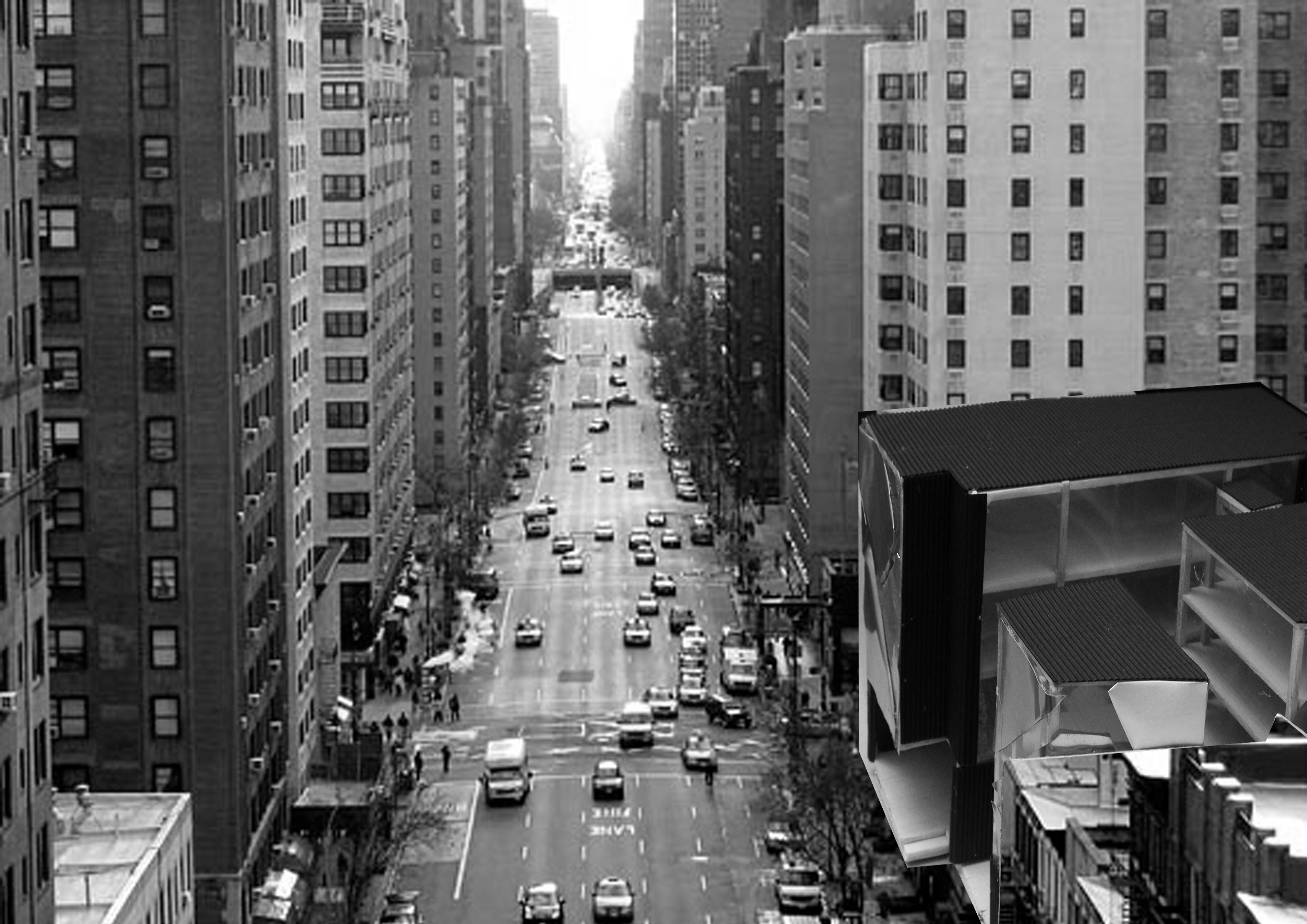
| dc.description.abstract | The final design of Flux has changed dramatically from what was presented in the initial concept in terms of form, ideas, function and inspiration. However the main concept of Flux has remained, that is the fluid circulation of people in and around structures. Flux has now been redesigned primarily as a train station with its secondary function being a shopping complex. This is an insurance of a constant flow of people. The irregularity of the initial form has been replaced with blocks that have been influenced by the frames of basic comic book pages. The methods of visual flow, which the comic book artist creates in his pages, have been a huge influence to Flux. Not only do they provide cultural relevance to New York, but they also provided the ideas behind the circulation in Flux. This has allowed for a dramatic increase in circulation and functional space. The new form is a logical change. The train station is five floors, which is made up of three retail floors, a station terminal, and underground platforms. The retail floors are connected to the secondary towers through a collection of sky bridges allowing for easy and fluid access. The terminal is accessible from both sides of the street for the convenience of commuters and for logical circulation. The platforms are sealed with glass barriers that open when trains arrive, the strength of this lies in the comfort and safety of commuters. The secondary towers that site adjacent to the station are six and four floors each. They are solely retail spaces and each have a circulatory halve. The six-floor building leans in towards the plaza between the three structures. This plaza is designed to accommodate functions and events such as night markets, political rallies, busking space and for general relaxation. | en |
| dc.language.iso | en | en |
| dc.relation.ispartof | Nine Quarter City | en |
| dc.relation.haspart | G8 | en |
| dc.rights | Other | en |
| dc.subject | Architecture | en |
| dc.subject | Design | en |
| dc.subject | Studio | en |
| dc.subject | Nine Quarter City | en |
| dc.subject | Model | en |
| dc.subject | Drawing | en |
| dc.title | DESA1002 'Nine Quarter City' - <Lionel Puang> | en |
| dc.type | Image | en |
| dc.description.unitofstudy | DESA 1002 (Design and Practice) | en |
| dc.rights.other | Author retains copyright of this work | en |
| usyd.faculty | Sydney School of Architecture, Design and Planning, Student works | en |
| usyd.department | Architecture & Allied Arts | en |
Associated file/s


Associated collections